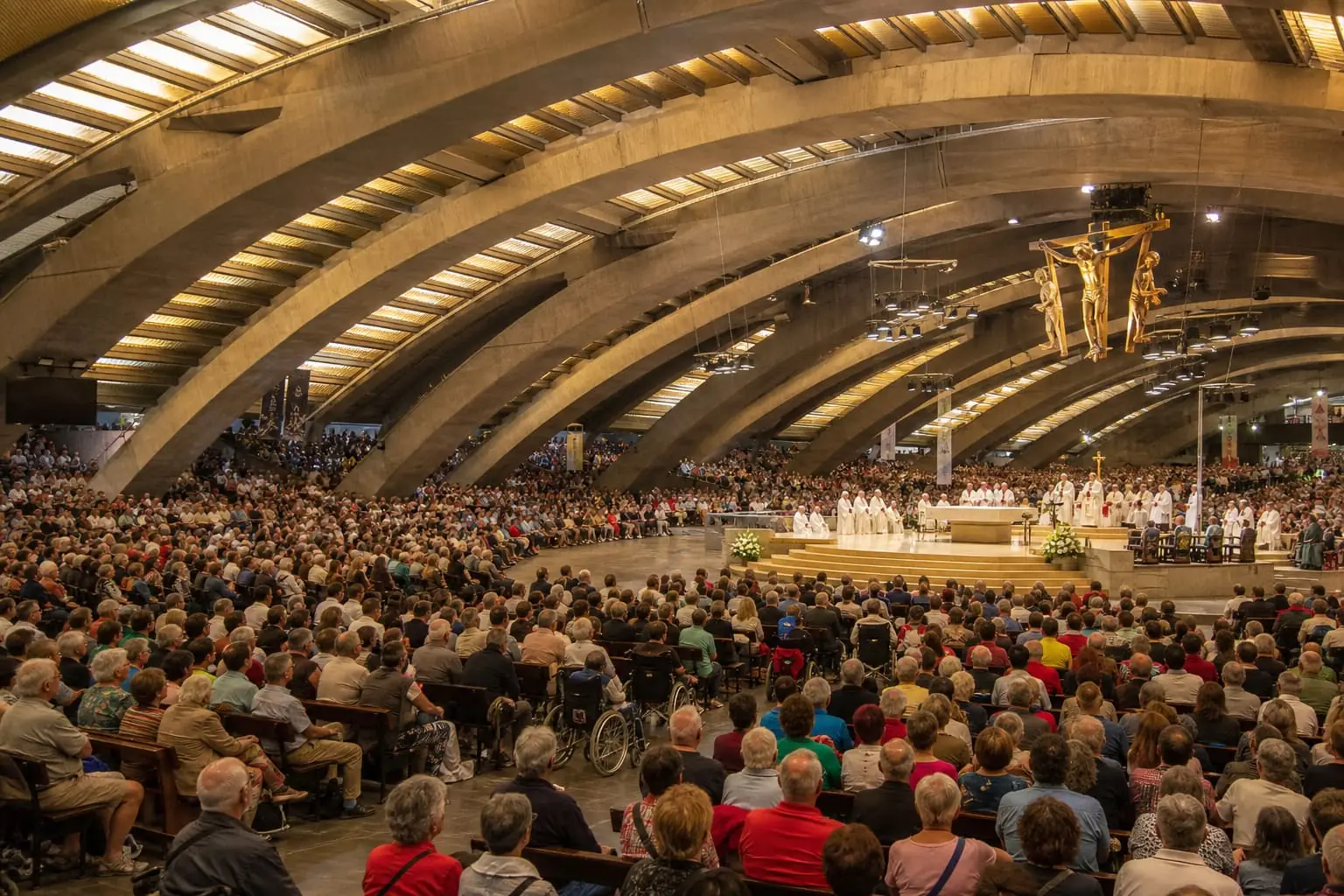
Beneath the Esplanade of the Lourdes Sanctuary, accessed by gentle ramps on either side, lies one of the most extraordinary religious buildings of the twentieth century. The Basilica of Saint Pius X was consecrated on 25 March 1958 for the centenary of the apparitions, and remains the largest underground church in the world. It can accommodate 25,000 people. This is not a building that is merely large; it is one that uses scale in the service of awe, creating a space where the individual pilgrim is simultaneously diminished by vastness and lifted by beauty.
History and Consecration
Plans for a centenary basilica began in the early 1950s, when the Sanctuary's leadership recognised that the two existing basilicas (the upper Basilica of the Immaculate Conception and the lower Basilica of the Rosary) could not accommodate the vast numbers of pilgrims gathering for special occasions. The architect chosen was Pier Luigi Nervi, the great Italian engineer-architect known for his mastery of reinforced concrete. Nervi designed an elliptical underground structure 201 metres long and 81 metres wide, supported by concrete ribs that create the impression of an enormous shell or upturned hull. Pope Pius XII sent a papal legate to consecrate the basilica on 25 March 1958; the pope himself had approved the project and contributed personally to its funding.
Nervi's Architectural Achievement
The engineering of the Basilica of Saint Pius X is genuinely remarkable. The underground structure supports the entire Esplanade above it, including the weight of tens of thousands of pilgrims during processions. Nervi's solution was a web of reinforced concrete arches radiating from central columns, creating both structural integrity and a soaring visual rhythm. The interior is lit by natural light through peripheral windows at ground level and by artificial light that suffuses the arched ceiling. The overall impression is of being inside the ribcage of a great creature — vast, organic, protective. The acoustics, carefully designed to handle 25,000 voices simultaneously, produce a sonic experience that must be heard to be understood.
What to See and Do Inside
The main nave of the basilica hosts the large international Masses that occur on feast days and during major national pilgrimages. At other times, the space is available for private prayer and group Masses on side altars. The Adoration Chapel at one end of the basilica maintains perpetual adoration of the Blessed Sacrament — one of the most peaceful spaces in the entire Sanctuary domain. A series of mosaic panels depicting scenes from the life of Bernadette and the history of Lourdes lines the perimeter and rewards close study. The Way of the Cross installations within the basilica are used when outdoor ceremonies are impossible.
Practical Visitor Information
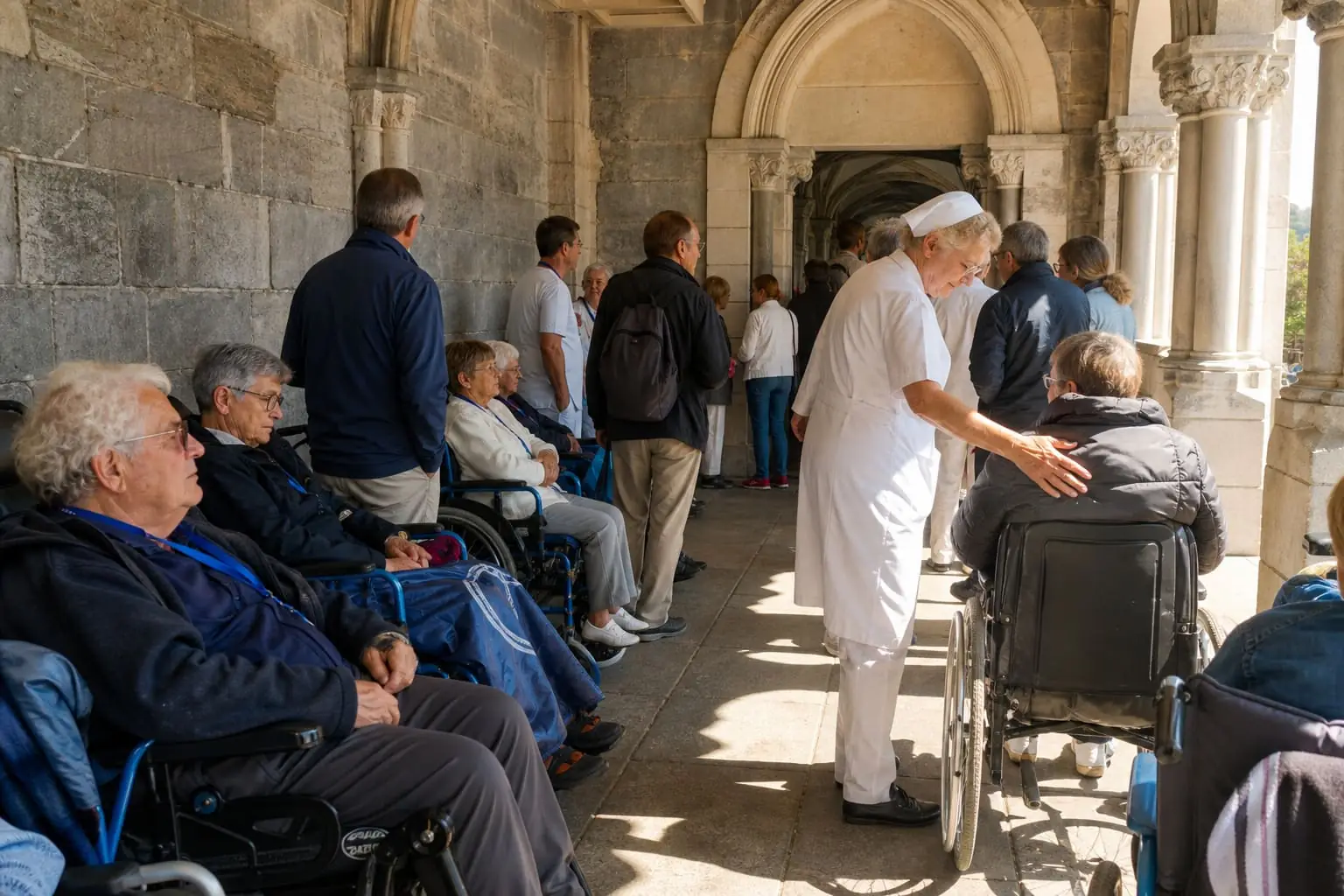
The Basilica of Saint Pius X is accessed via two main entrance ramps, one on each side of the Esplanade. It is fully accessible for wheelchairs and voiturettes with no steps at any point. The basilica is open during standard Sanctuary hours (check the Sanctuaires app for current times). Mass is celebrated here for large gatherings; check the programme for scheduled Masses in your language. The basilica is cool even in summer — bring a layer. Photography is permitted throughout the basilica but should be done respectfully and not during liturgical celebrations.
Why This Basilica Matters Spiritually
Some visitors enter the underground basilica and find it initially disorienting: too large, too modern, too far from the intimate simplicity of the Grotto. But spend an hour inside — particularly in the Adoration Chapel at one end — and the space does its work. There is a particular quality of silence that 25,000-person buildings achieve when empty, or nearly so: a hush that is not merely the absence of sound but the presence of accumulated prayer. The Basilica of Saint Pius X has hosted some of the most significant moments in twentieth-century Catholicism, including multiple papal visits. Its walls have absorbed something of those encounters, and pilgrims sensitive to such things feel it.
Ready to plan your Lourdes pilgrimage?
Our team will build a personalised itinerary and send you a free quote within 1 hour.
Request Free Quote