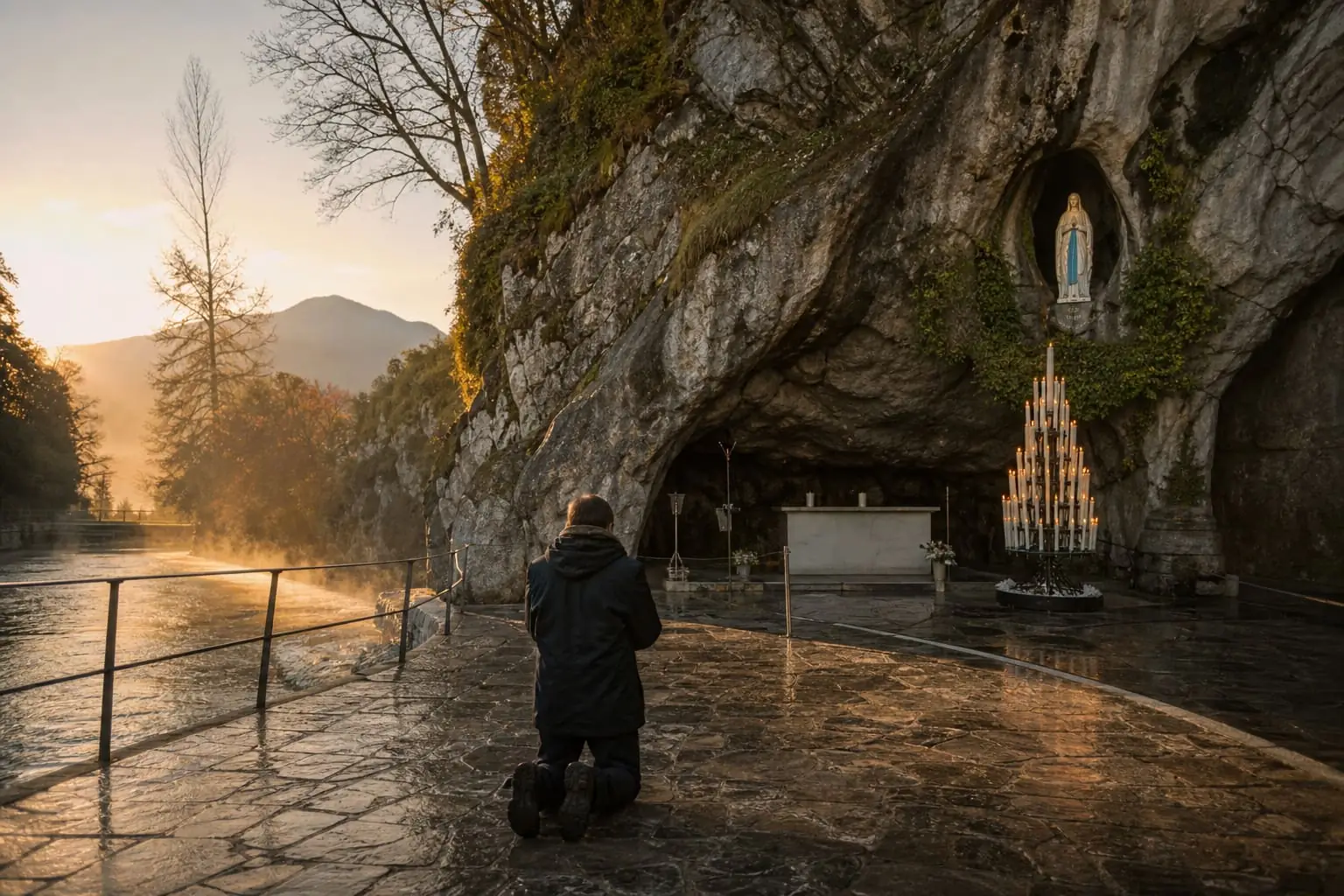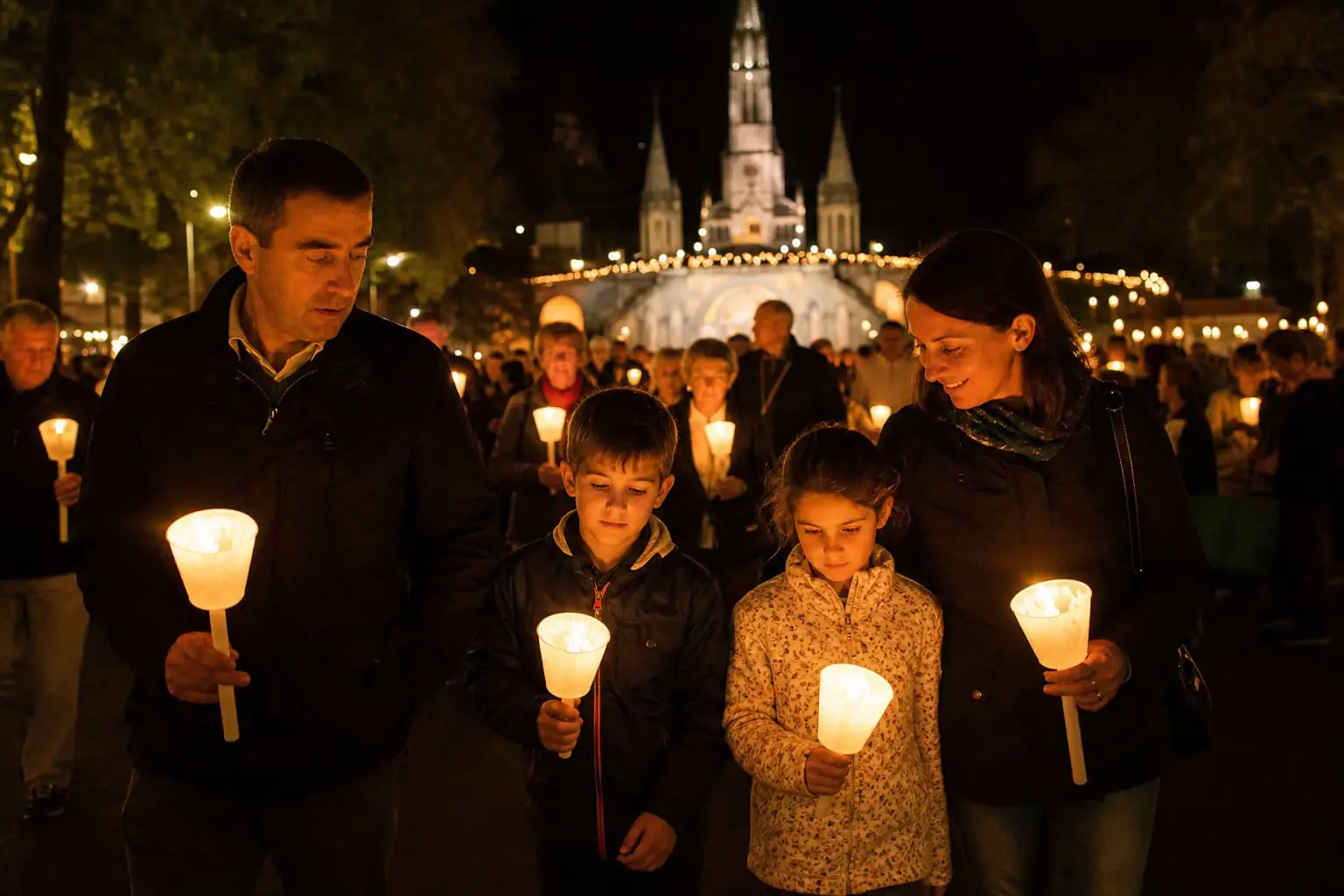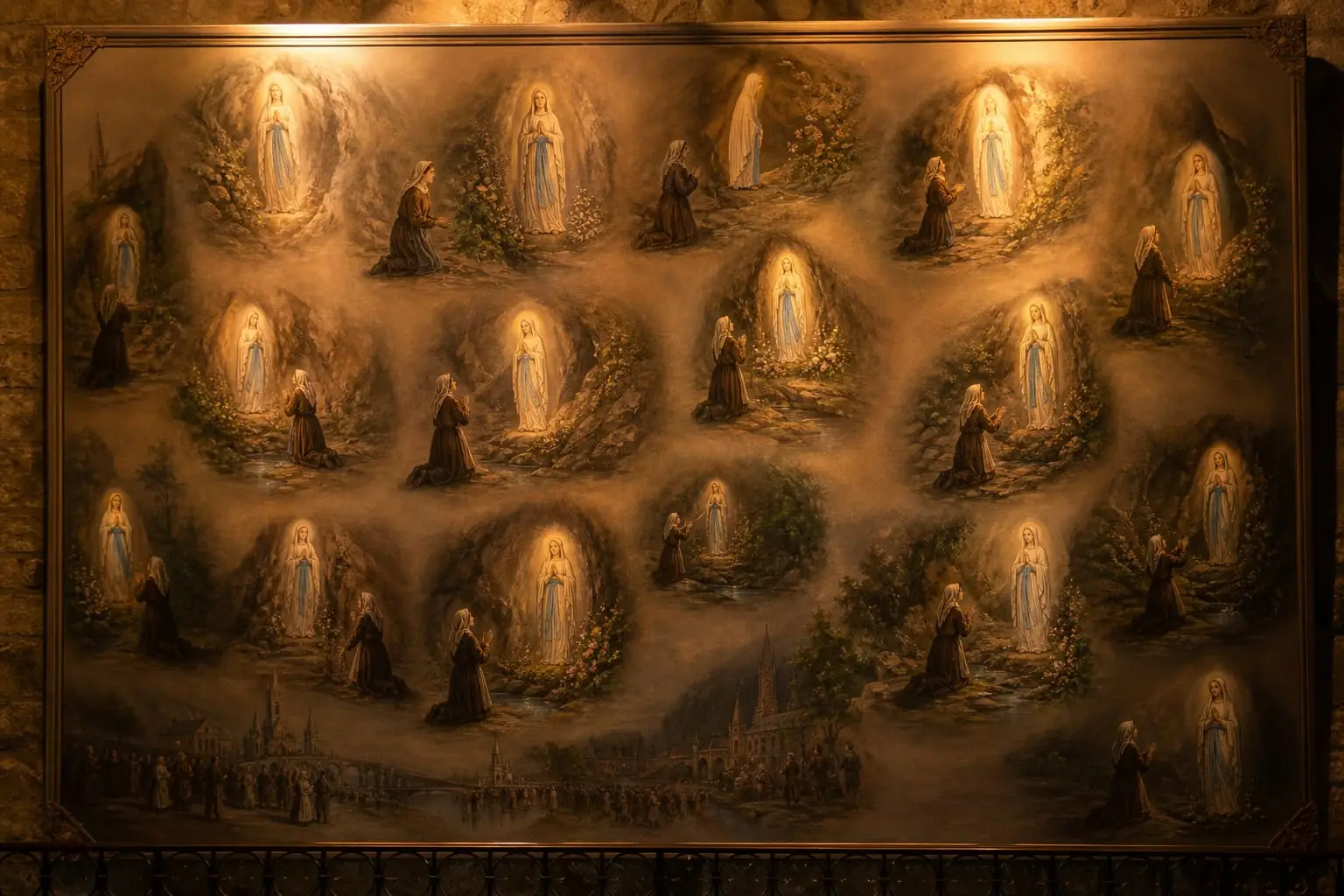
The eighteen apparitions that Bernadette Soubirous reported at the Grotto of Massabielle took place over approximately five months in 1858, from 11 February to 16 July. They were not uniformly dramatic: some were brief and wordless, others involved extended dialogue, messages to carry to the priests, and instructions that would eventually reshape the landscape of the Sanctuary. Understanding the chronology — what was said, to whom, and when — is essential both for pilgrims visiting the Grotto and for anyone wishing to understand what the Lourdes apparitions actually claimed.
The First Apparition: 11 February 1858
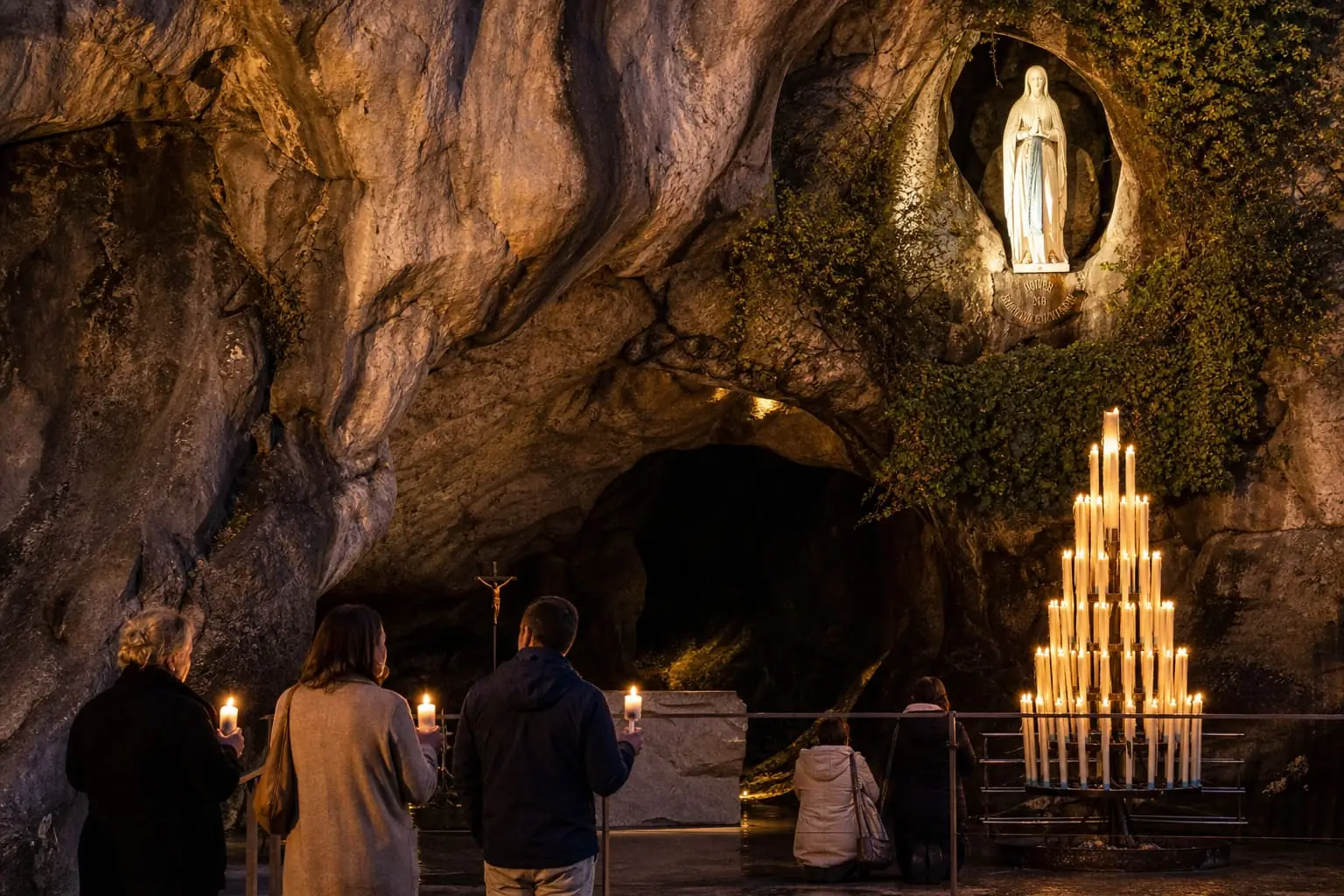
Bernadette, her sister Toinette and a friend went to the Grotto of Massabielle to collect wood and bones that could be burned for fuel. Near the cave, Bernadette heard a sound like rushing wind and saw a white light in the niche of the rock. Within the light was a young woman dressed in white, with a blue sash and a white veil, yellow roses at her feet, and a rosary of white beads with a gold chain over her right arm. The figure began moving the beads of the rosary. Bernadette fell to her knees and tried to pray her own rosary; her hand shook too much to make the Sign of the Cross until the woman made it first. The vision then disappeared. Toinette and the friend saw nothing. Bernadette initially told no one what she had seen.
The Early Apparitions and the Growing Crowd
The second apparition (14 February) occurred when Bernadette returned with friends who threw holy water at the niche; the figure only smiled. The third (18 February) brought the first words: the Lady asked Bernadette to come to the Grotto for fifteen days. By the fourth and fifth apparitions, crowds had begun gathering, some in the hundreds. The Lady asked for prayer for sinners. During the sixth, seventh, and eighth apparitions (21 February–24 February), local authorities began attempting to stop the gatherings. The Commissioner of Police Jacomet interrogated Bernadette but could not unsettle her testimony. Magistrate Dutour ordered her committed to an asylum; her father resisted. The bishop of Tarbes ordered clergy not to take sides.
The Ninth Apparition and the Spring
The ninth apparition (25 February 1858) is among the most significant in the entire sequence. The Lady told Bernadette to go to the spring and drink and wash there. Bernadette, confused (there was no visible spring), scratched at the muddy ground near the cave. Muddy water appeared. She drank it and washed her face with it, to the mockery of the watching crowd. Within a day, the trickle had cleared into a spring producing clean water. Almost immediately, reports of healings associated with the water began to circulate. The spring has flowed continuously ever since, now producing approximately 35,000 litres per day.
The Command to Build a Chapel
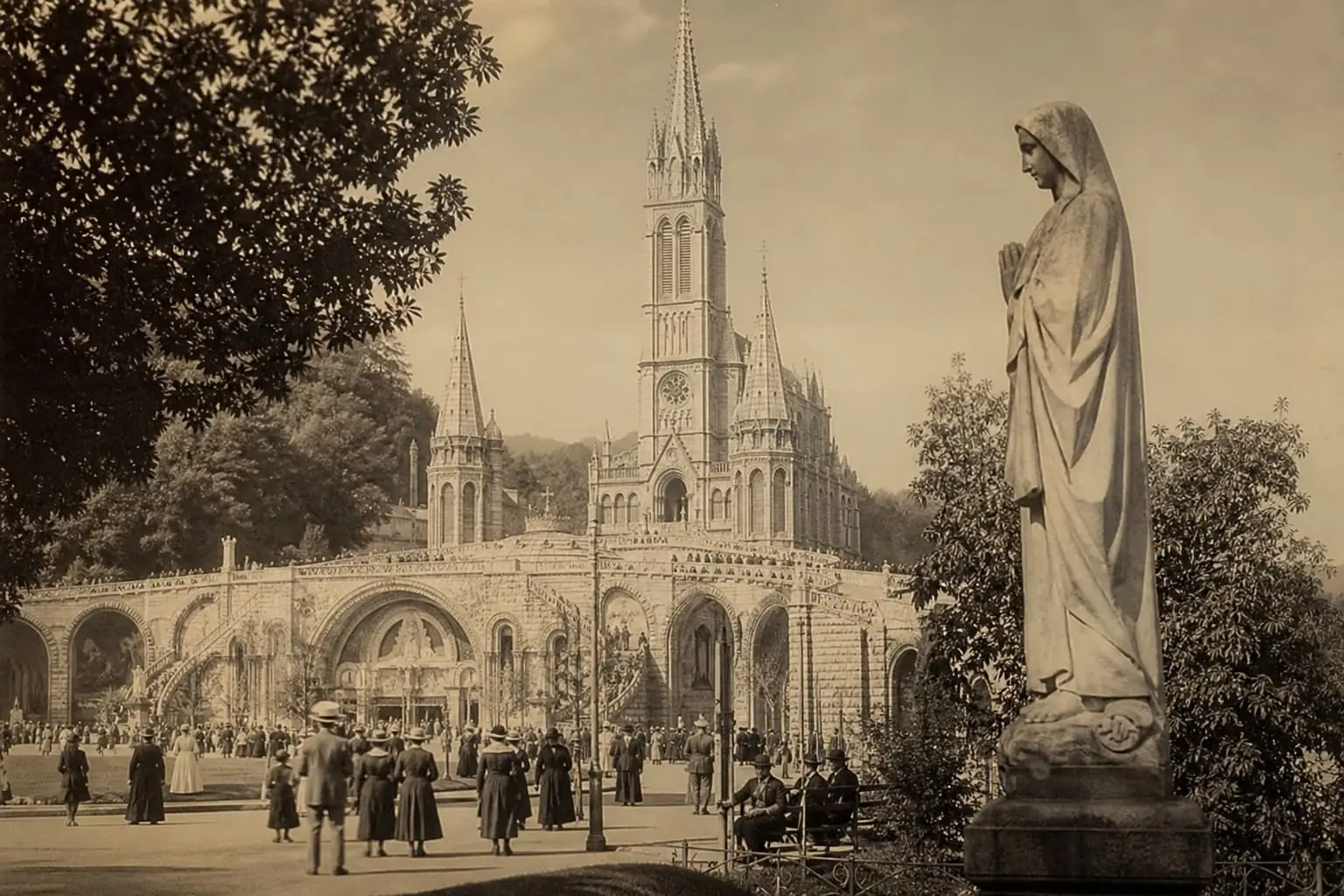
During the thirteenth apparition (2 March 1858), the Lady gave Bernadette a message to take to the priests: they were to come to the Grotto in procession, and a chapel was to be built there. Bernadette delivered this message to the parish priest, Father Peyramale, who was sceptical and demanded proof: he wanted the Lady to cause the wild rosebush at the Grotto to bloom, and he wanted to know her name. Bernadette returned this request to the Lady, who smiled but did not comply with the rosebush request. The request for a chapel — eventually fulfilled by three successive basilicas built above the Grotto — became the defining architectural legacy of the apparitions.
The Revelation of the Name
The sixteenth apparition (25 March 1858, the Feast of the Annunciation) is the most theologically significant. On each previous occasion that Bernadette had asked the Lady her name, the figure had only smiled. On this day, after Bernadette had asked four times, the Lady joined her hands in prayer, raised her eyes to heaven, and said: "Que soy era Immaculada Councepciou" — "I am the Immaculate Conception." Bernadette immediately ran to Father Peyramale, repeating the phrase she did not understand. Peyramale was stunned: the Immaculate Conception was the precise formulation of the dogma proclaimed by Pope Pius IX just four years earlier. This declaration became, for the commission of inquiry and ultimately for the Church, one of the most compelling arguments for the authenticity of the apparitions.
The Final Apparition: 16 July 1858
After the fifteenth apparition (4 March), a considerable interval followed. The sixteenth was on 25 March; the seventeenth on 7 April, during which witnesses reported that Bernadette held her hand over a candle flame for fifteen minutes without any sign of burning or pain — an episode noted by witnesses but never fully explained. The eighteenth and final apparition took place on 16 July 1858, the Feast of Our Lady of Mount Carmel. The Grotto area had been barricaded by the civil authorities. Bernadette came to the bank of the Gave river opposite and saw the Lady across the water, more beautiful than ever, she later said. No words were spoken. The Lady smiled, and then was gone. It was the last vision. Bernadette described it as the most beautiful of all.
The Church's Investigation and Approval
Bishop Bertrand-Sévère Laurence of Tarbes appointed a commission of inquiry that spent four years investigating the apparitions, the character of Bernadette, the spring healings, and the consistency of the testimony. On 18 January 1862, after receiving the commission's report, the Bishop issued his pastoral letter declaring the apparitions "worthy of belief" — the standard Catholic formula for approving private revelations. This formal approval came nearly four years after the last apparition, reflecting the Church's deliberate caution in such matters. Bernadette was not present for the declaration; she had asked to be treated as an ordinary novice at Nevers and expressed no interest in the Church's official conclusions about what she had seen.
Ready to plan your Lourdes pilgrimage?
Our team will build a personalised itinerary and send you a free quote within 1 hour.
Request Free Quote