Marie-Bernarde Soubirous was born on 7 January 1844 at the Boly Mill in Lourdes, the first child of François Soubirous and Louise Castérot. The family was comfortable at her birth but spiralled into poverty through the 1850s, ending in the Cachot — a single room in a former prison — by 1858. She was the girl chosen, at fourteen, to carry one of the most significant religious events in modern history. And then she spent the rest of her life trying to be forgotten. Understanding both the visions and the woman who received them is essential to understanding Lourdes itself.
Childhood Poverty and the Cachot
The descent from the Boly Mill to the Cachot took most of Bernadette's childhood. Her father's business failures, a series of misfortunes and the death of a creditor who might have helped them left the family destitute by the mid-1850s. The Cachot — the room in which the family of six lived in 1858 — measured approximately four metres by four metres, damp and poorly lit, in a building that had previously served as a prison because it was considered unfit for human habitation. Bernadette's health was already poor: she suffered from asthma that would trouble her for the rest of her life. She had received almost no formal education and spoke only the local Bigourdan dialect. She was, in every worldly sense, entirely unremarkable.
The Eighteen Apparitions
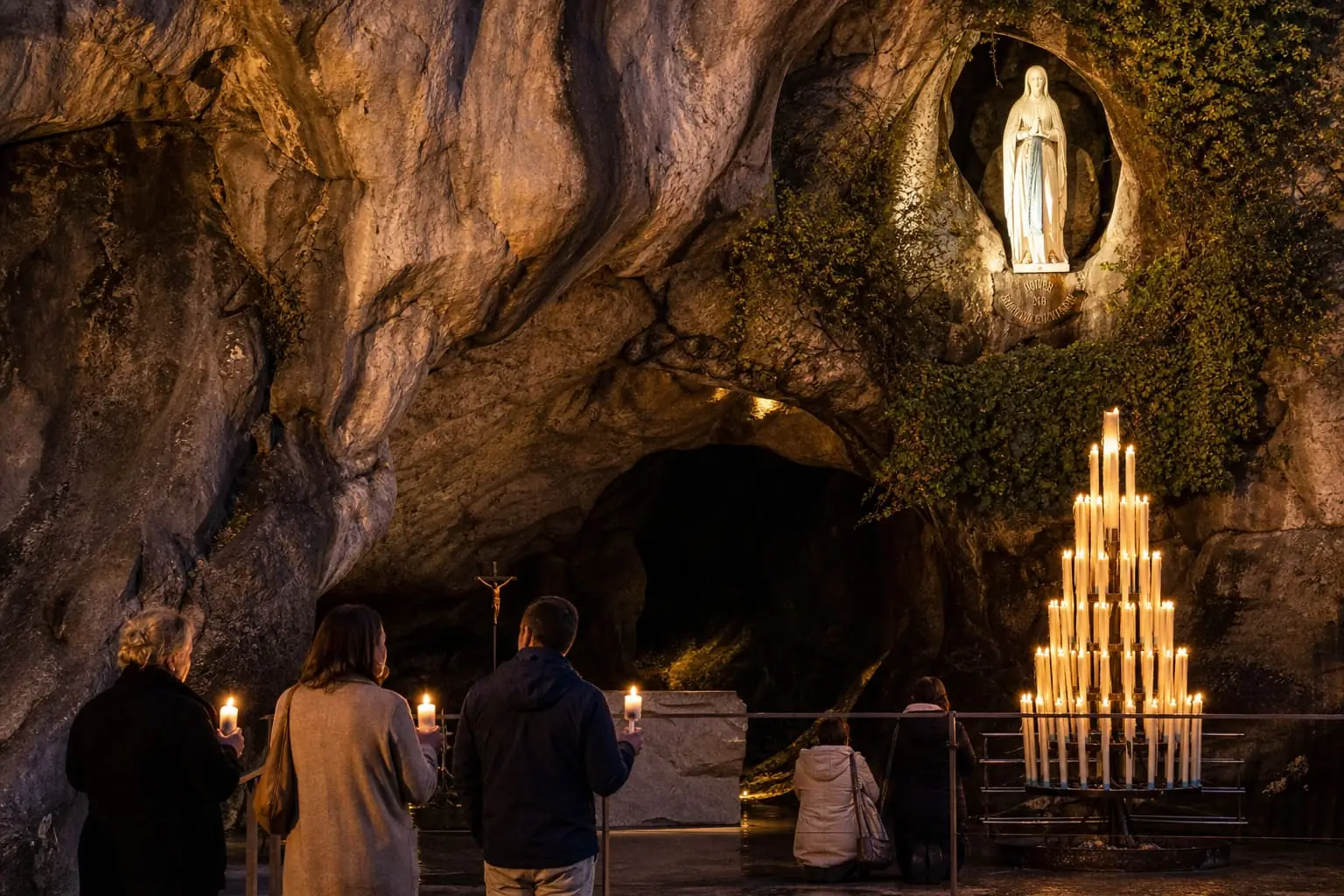
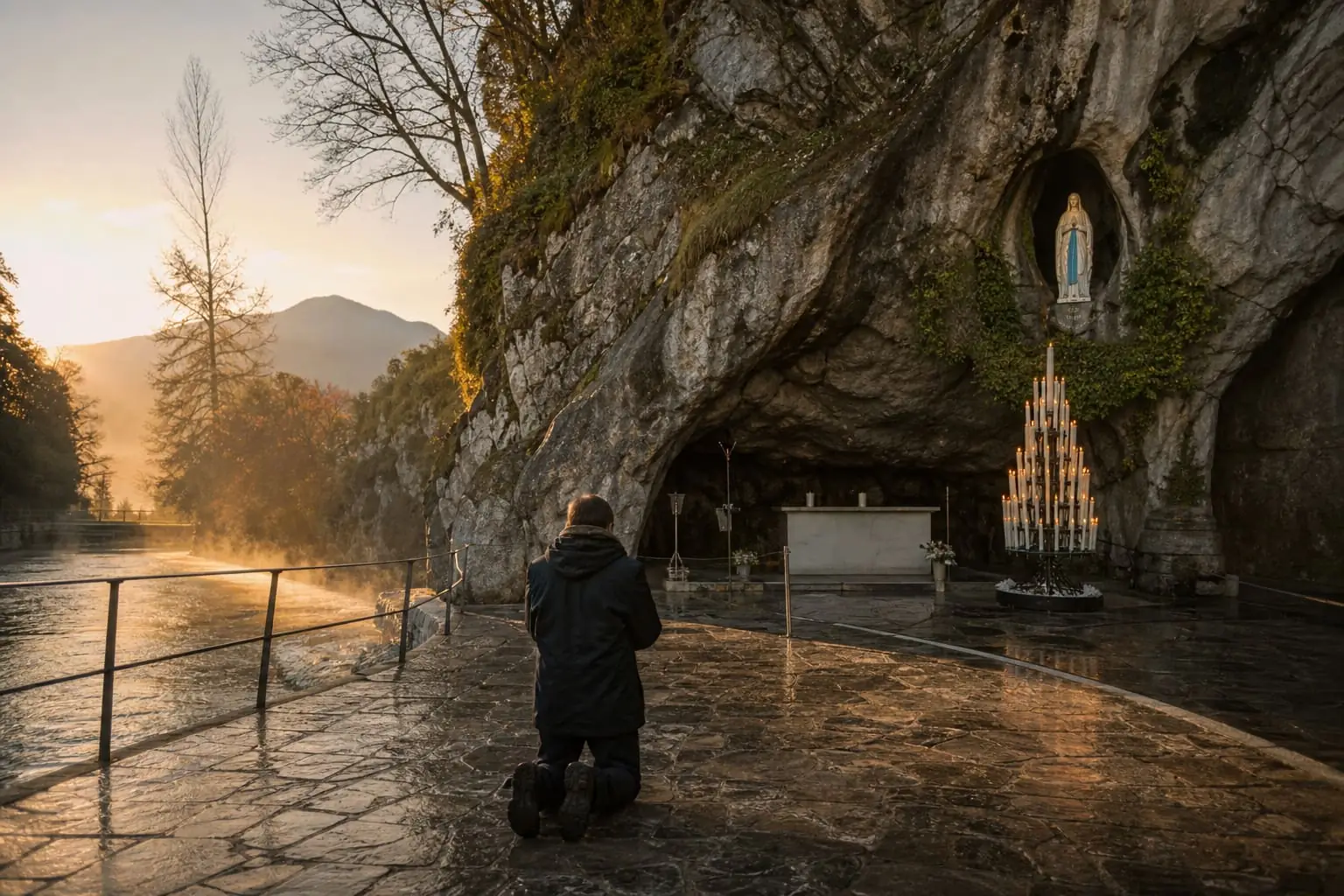
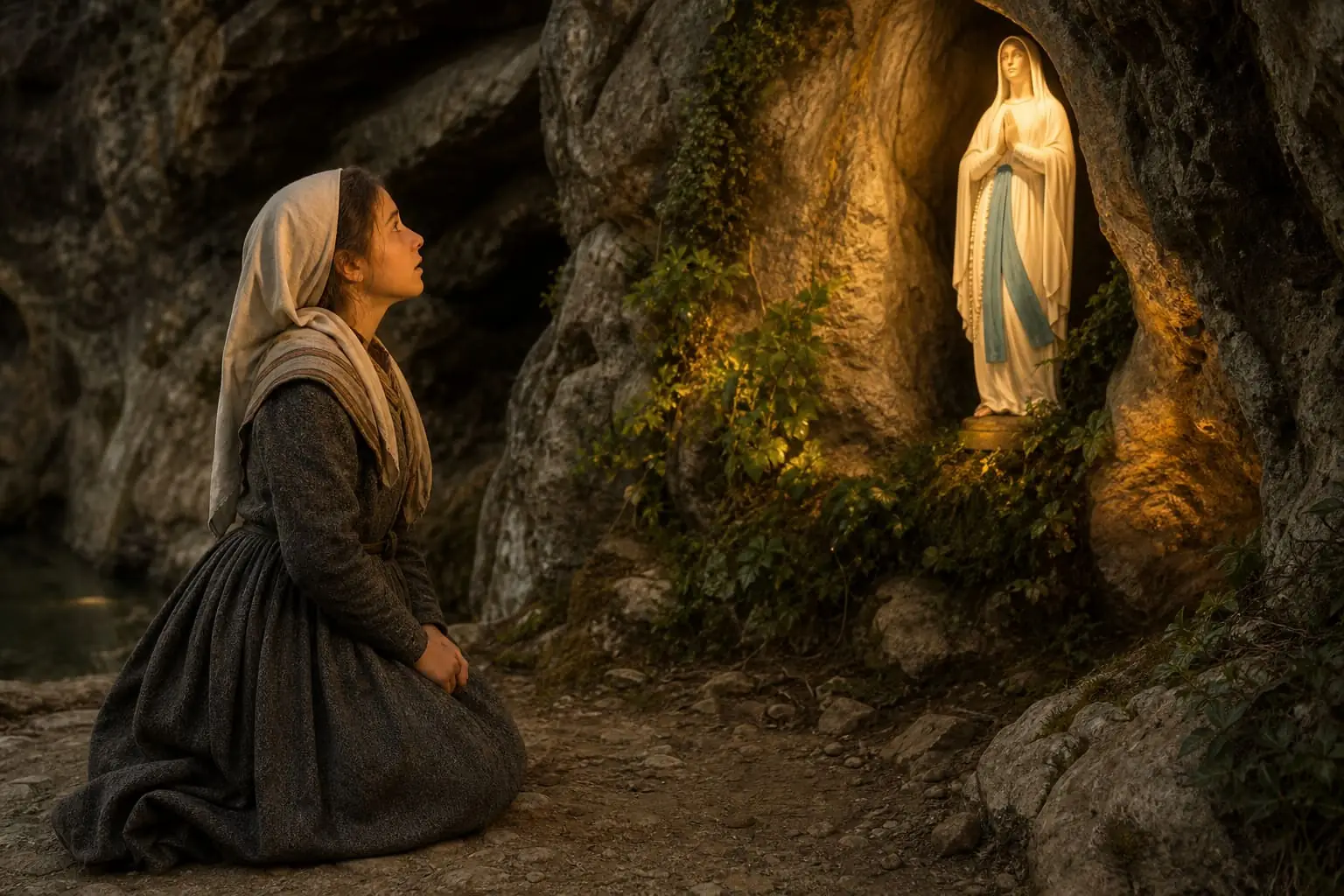
From 11 February to 16 July 1858, Bernadette experienced eighteen apparitions of a woman she described as "a beautiful lady" at the Grotto of Massabielle on the edge of Lourdes. She refused, initially, to identify the figure as the Virgin Mary — she called her Aquero, the local patois word for "that one." The Lady asked for prayer, penance, processions, and the building of a chapel. She revealed a spring. In the sixteenth apparition, she gave Bernadette the phrase "I am the Immaculate Conception" — words Bernadette could not explain, having no theological education. This phrase, identifying Mary as she was defined in the dogma proclaimed by Pius IX in 1854, became one of the most significant elements in the Church's eventual approval of the apparitions.
The Interrogations and Bernadette's Character
Throughout the period of the apparitions and for years afterward, Bernadette was subjected to intense interrogation by civil police, magistrates, doctors, and priests. Her testimony never varied. She described what she saw with simple consistency, showing no signs of fabrication, seeking no financial benefit, and refusing embellishment. Those who interrogated her noted a quality that unnerved them: an absolute calm combined with a complete inability to say anything other than exactly what she had experienced. The Commissioner of Police Louis Jacomet subjected her to his most rigorous methods and reported, reluctantly, that he could find no reason to doubt her. The local parish priest, initially sceptical, became one of her most important defenders. Bernadette's character — humble, direct, occasionally sharp — remained constant through the celebrity and pressure that followed.
Life at Nevers
After the apparitions ended, Bernadette was educated by the Sisters of Charity of Nevers in Lourdes, then entered their congregation at Saint-Gildard Convent in Nevers in 1866. She made her religious vows in 1867, taking the name Sister Marie-Bernarde. She asked, on entering the convent, to be treated like any other novice and never to be asked about the apparitions in community. Life at Nevers was marked by increasing physical suffering: tuberculosis of the bone in the knee, tuberculosis of the lungs, and multiple other illnesses kept her largely bedridden through her final years. She described her suffering with characteristic directness: "I didn't say I wouldn't suffer. I said I wouldn't be afraid."
Death and Canonisation
Bernadette died on 16 April 1879, aged 35. Her final words were a prayer to Our Lady. She was exhumed three times during the canonisation process — in 1909, 1919, and 1925 — and on each occasion her body was found to be remarkably preserved, without the expected signs of decomposition. She was beatified by Pope Pius XI on 14 June 1925 and canonised on 8 December 1933. Her incorrupt body is enshrined today in a glass reliquary in the Chapel of Saint Gildard at the Nevers convent, where it can be venerated by pilgrims.
What Her Life Means for Understanding Lourdes Today
Bernadette's life after the apparitions is not a postscript to the Lourdes story — it is integral to it. She deliberately spent her remaining years out of the public eye, suffering in obscurity, never seeking the fame that the apparitions had thrust upon her. She consistently deflected attention from herself to the message she had been asked to carry. For pilgrims who visit Lourdes, understanding this dimension of Bernadette — the canonised saint who asked to be forgotten — reframes the entire Sanctuary. Lourdes is not a monument to Bernadette. It is a continuation of what she was asked to build: a place of prayer, penance and encounter with Our Lady, sustained not by celebrity but by faith.
Ready to plan your Lourdes pilgrimage?
Our team will build a personalised itinerary and send you a free quote within 1 hour.
Request Free Quote